
Alphaverse + the In-Product NFT Marketplace
Most metaverses bolt the marketplace on the side. Users leave the world to buy the asset, and never come back.
The Problem
A metaverse with a separate marketplace site is two products. The user enters the world, finds an asset they want, opens a new tab, navigates to the marketplace site, connects their wallet again, completes a purchase, and — if they remember — returns to the world to use what they bought. Most don't return. The session ends at the purchase.
The marketplaces that drive volume inside metaverse environments are the ones embedded into the world itself. The wallet handshake happens once. The asset acquisition happens in-environment. The user never leaves the experience.
That's the architectural pattern AlgoCoder built across the CBI metaverse portfolio.
Alphaverse — the HUB metaverse environment
Alphaverse is the HUB metaverse environment in the CBI engagement. It functions as a central social and commercial space connecting the broader metaverse ecosystem CBI commissioned. Alphaverse carries an embedded NFT marketplace as a core architectural feature — not a side surface.
Visitors enter Alphaverse, browse marketplace surfaces in-world, and complete acquisitions without leaving the environment. The wallet connection persists across the visit. Assets acquired in-environment become immediately available to the user for use in the broader metaverse network.
The MetaCoaster in-product marketplace
The same architectural pattern is implemented inside MetaCoaster (see the previous case study). Park-related assets, characters, and items live in an in-product marketplace surface. Players acquire assets without leaving the simulation.
The verifiable proof surface — OpenSea
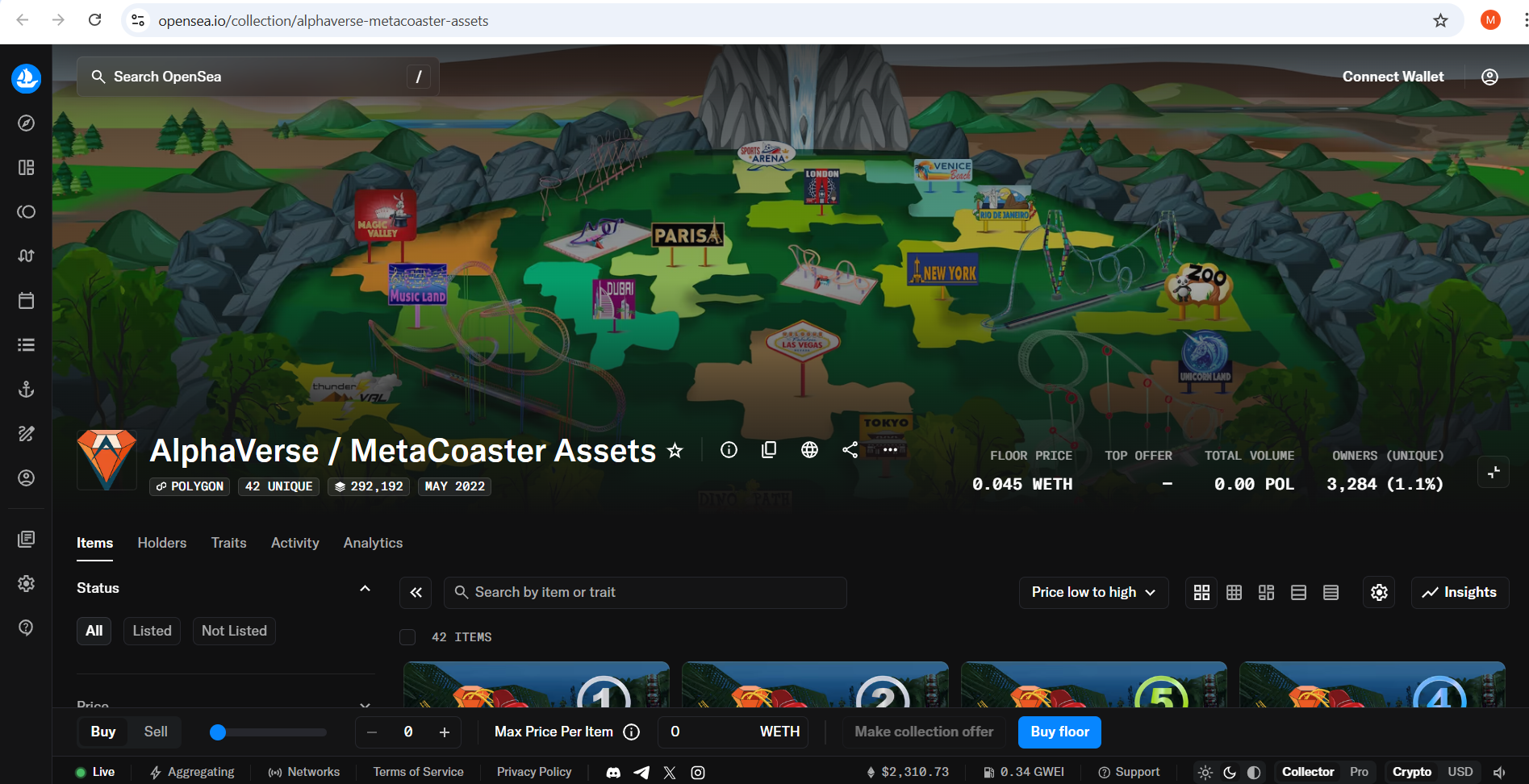
The NFTs minted via the in-product marketplaces inside MetaCoaster and Alphaverse are publicly verifiable on the OpenSea collection today.
The numbers, exactly as they appear on the public OpenSea collection:
- 292,000+ NFTs minted on Polygon
- 3,284 unique holders
Critical attribution language: AlgoCoder built the in-product NFT marketplace inside MetaCoaster and Alphaverse for CBI. The NFTs minted via these in-product marketplaces were distributed via OpenSea, where they remain verifiable today.
OpenSea is not a platform AlgoCoder built. OpenSea is the public ledger surface where the proof of the in-product marketplace work exists. The volume on OpenSea is the public verification that the marketplace shipped, ran in production, and reached real users.
The six metaverse environments
The CBI engagement produced six metaverse environments. Alphaverse is one of them, plus:
- Horyou — metaverse environment delivered for CBI
- Qtopia — metaverse environment delivered for CBI
- Night League — metaverse environment delivered for CBI
- Rave Age — metaverse environment delivered for CBI
- Artech — metaverse environment delivered for CBI
Each environment is a distinct metaverse product with its own theme, layout, and audience — engineered to the same production-grade standard as Alphaverse and MetaCoaster.
What this case proves
Six metaverse environments shipped to production for a Euronext-listed enterprise. Embedded in-product marketplaces driving real on-chain volume — 292,000+ NFTs minted on Polygon across 3,284 unique holders, publicly verifiable. Multi-year engagement. Production work, not pilots.