
The Storefront That Doesn't Lose the Visitor at the Door
Standard ecommerce can't recreate the discovery experience of walking through physical stacks. The browse-to-buy bridge breaks the moment the visitor leaves the storefront.
The Problem
Public institutions — libraries, museums, university presses, cultural archives — face an engagement problem that traditional ecommerce surfaces can't solve. The institution's value to its public has historically been the discovery experience: walking through the stacks, browsing without a search query, finding something serendipitously, picking up the physical object and reading the first page before deciding to take it home.
A standard ecommerce site doesn't recreate that. A search bar plus a grid of book covers is functional, but it converts the institution's value proposition into a transactional one. The visitor lands, types a query, scans results, makes a decision. Discovery is gone. The institution becomes interchangeable with any other online seller of books.
The institutions that maintain their cultural identity in digital form are the ones that engineer the digital surface to carry the experiential weight of the physical space — the stacks, the curated displays, the readability surfaces that let a visitor preview before purchasing. That requires environment design, not catalog software.
What we built
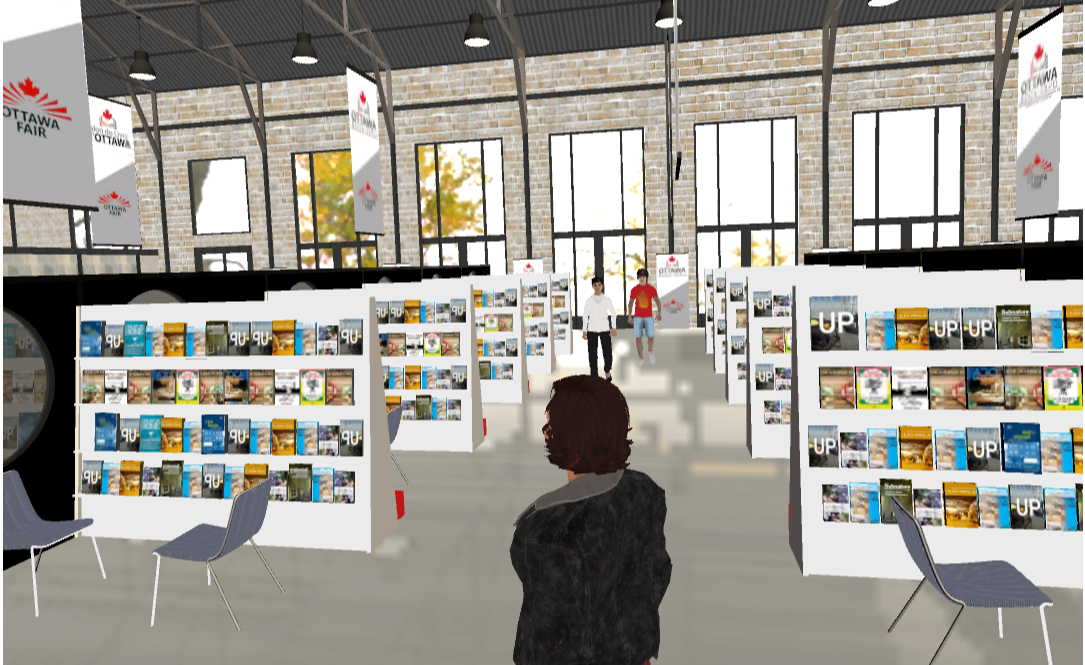
An immersive metaverse expo center for a nationally-recognized Canadian public library institution. The expo center is engineered as a navigable 3D venue where visitors browse curated book collections, read titles in-environment, and complete purchases without leaving the experience.
Full 3D venue design — The expo center is a designed venue, not a generic 3D template. The architecture, the curatorial layout, the spatial logic of how collections are arranged — all engineered specifically for the institution's curatorial voice.
In-environment book preview surfaces — Visitors can preview titles directly inside the metaverse. The preview surfaces are engineered to make the reading experience feel native to the environment, not a popup overlay that interrupts the spatial experience.
Integrated commerce path — Discovery, preview, purchase — all completed inside the expo center without the visitor leaving the experience. The wallet handshake is engineered into the venue's entry layer, not surfaced as a separate transactional step.
Curatorial flexibility — The expo format allows the institution to mount different curated collections over time, the same way a physical institution would rotate exhibitions. The metaverse is engineered as a curated venue, not a static catalog.
What this case proves
Production-grade cultural metaverse environment tying a recognized institution's identity to a digital commerce surface that preserves the experiential weight of the physical space. The model translates directly to:
- Museums — exhibition surfaces that drive shop revenue without the museum surrendering its curatorial identity
- University presses — scholarly publishing in a discovery surface that matches the publisher's editorial voice
- Cultural archives — public-access surfaces that make collections explorable in spatial form
- Tourism boards — destination-marketing surfaces that carry regional cultural detail
- Galleries — sales surfaces that maintain the gallery's curatorial framing
The metaverse in this engagement is not a marketing surface. It is the storefront. The architectural decision to build it that way — to put commerce inside the experiential venue rather than alongside it — is what makes the case a credential for cultural institutional metaverse work generally.