
Walking the Land Without Crossing the Continent
Buyers of multi-million-dollar properties expect to walk the land before they wire the funds. Physical visits don't scale across a buyer pipeline.
The Problem
The highest-end residential real estate has a buyer-pipeline problem that doesn't apply to ordinary properties. A buyer considering a multi-million-dollar cottage on a remote estate doesn't make the decision from a brochure. They expect to walk the land, look at the surrounding terrain, see the views from the actual unit, get a feel for the natural setting that justifies the price. For local buyers, that means a site visit. For international buyers — who often represent a significant portion of luxury real estate demand — site visits don't scale. A buyer in Singapore considering a property in the US Pacific Northwest can't realistically visit five candidate units across a buying season.
The marketing video doesn't close the gap. A drone fly-over and a glossy edit don't replicate the experience of standing on the property and looking at the mountains. What does replicate the experience — at least closely enough to qualify a buyer's interest before they fly in for a final visit — is a real-property metaverse tour rendered to production quality.
That's the work AlgoCoder was hired to deliver, and the work was delivered in approximately one week.
What we built
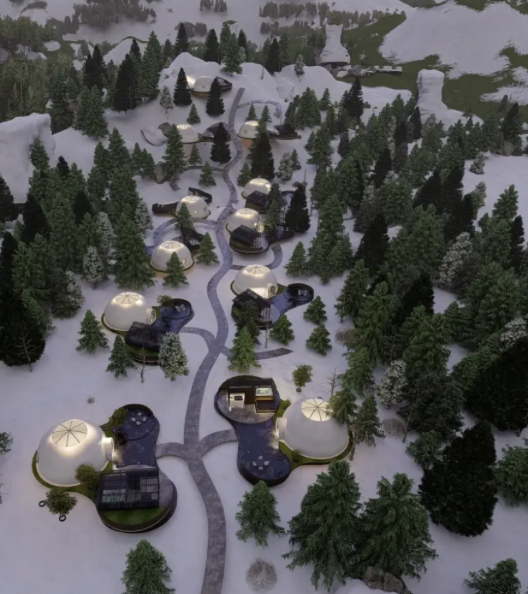
A real-property metaverse tour for a US luxury real estate developer marketing VIP cottage units at the developer's Pacific Northwest site. The build replicated the actual physical property — terrain, surrounding mountains, natural setting, individually-priced cottage units — in a navigable real-time 3D environment.
Site location and physical context — The property is at 10257 Old Mount Baker Highway, in the Pacific Northwest of the United States, set against two surrounding mountains in a peaceful natural setting. The terrain and the geographic context are part of what justifies the property's value — the metaverse build replicated the physical setting accurately, not as a stylized abstraction.
The cottage units — The developer was marketing individually-priced cottage units (referenced internally as "units") in the multi-million-dollar range per unit. Each unit was modeled and integrated into the navigable environment, allowing prospective buyers to walk through the property layout, view individual unit interiors, and understand the unit's relationship to the surrounding terrain.
The buyer experience — A qualified buyer enters the metaverse tour from any device, navigates the property in real-time 3D, walks through individual cottage units, and gets the spatial sense of the property without traveling to the site. The tour serves as the qualification surface — a buyer who completes the tour and remains interested is then a candidate for a physical site visit.
Delivery profile — approximately one week
The full end-to-end metaverse build was delivered in approximately one week. The compressed timeline is the case's secondary credential. The primary credential is the work itself; the secondary credential is the speed at which AlgoCoder converted physical-world high-value real estate into a buyer-grade digital experience. For a developer with active buyer interest who needed a marketing surface live before the next sales cycle, the speed was the value.
What this case proves
AlgoCoder converts physical-world high-value real estate into buyer-grade digital experiences on tight timelines. Capability demonstration of speed-to-production for a luxury real estate use case — full 3D environment design, terrain replication, individual unit modeling, navigable buyer experience — delivered in seven days.
The capability scales across luxury real estate as a category. The same engineering pattern applies to any high-value property where buyers can't easily visit physically and where the marketing surface needs to qualify interest at the level the asset price justifies.