
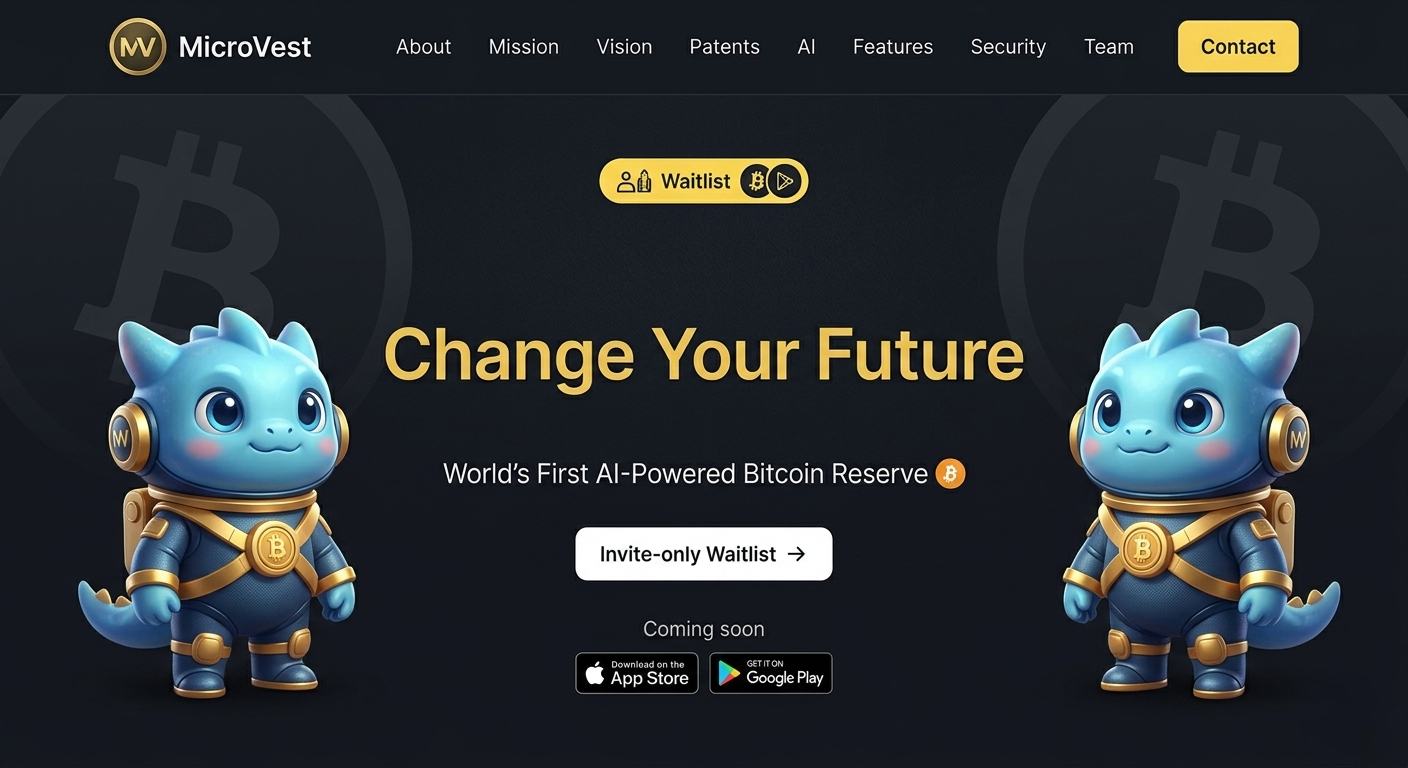
Microvest — AI Bitcoin Investment Platform
Most AI investment products demo a model. They never face a regulator, never hold custody, never reconcile a transaction at 3am, and never ship.
The Problem
The distance between an AI investment model that works in a notebook and an AI investment platform that ships to production through regulatory review is enormous. A model that backtests well is interesting. A model that runs against live market data, generates investment guidance for real users, holds custody of those users' funds, executes Bitcoin transactions on their behalf, and reconciles all of it under audit-grade controls — that's a product. Most AI investment startups never close the gap. The model is the easy part. The custody system, the transaction infrastructure, the regulatory posture, and the operational reliability are what separate a demo from a platform.
A Bitcoin investment platform raises the bar further. Custody of crypto assets requires architectural patterns that traditional finance custody doesn't. Transaction infrastructure has to handle on-chain confirmation lifecycles, fee market dynamics, and reconciliation against a settlement system that doesn't pause for business hours. Security has to be audit-ready by default — there is no margin for retrofitted security in a custody product.
What we built
End-to-end production engineering for the Microvest AI Bitcoin investment platform across four integrated layers. The platform is engagement-concluded, relationship-ongoing — the system is working and is in pre-launch.
Layer 1 — The AI engine — Real-time Bitcoin market data ingestion at the cadence the platform's investment intelligence requires. Sentiment signal analysis across the data sources that drive the model's market view. The output is data-backed investment intelligence — not generic market commentary, but personalized portfolio insights tied to the user's profile and the platform's risk framework.
Layer 2 — Custodian management system — This is where AI investment products usually fail. Microvest's custodian system is engineered for regulatory-grade custody:
- Encrypted key storage — Cryptographic key material is held in encrypted form, with the access patterns required for a custody product.
- Role-based access control — Administrative actions against custody are scoped to roles, authenticated, and logged.
- Regulatory-grade fund segregation — User funds are architecturally segregated from platform operating capital. The segregation is not policy — it's enforced at the architectural layer.
- Full audit trails — Every custody-related event produces a verifiable audit record, engineered for the regulatory scrutiny pattern the platform expects.
Layer 3 — Bitcoin transaction infrastructure — End-to-end on-chain transaction handling:
- Deposits and withdrawals — User-initiated movement of Bitcoin into and out of the platform, with the confirmation and reconciliation patterns the platform's risk framework requires.
- Real-time balance reconciliation — Platform-side balances are reconciled against on-chain state continuously, not in batch.
- Fee estimation — Transaction fees are estimated against current mempool conditions to balance confirmation speed against cost.
- On-chain transaction monitoring — Pending transactions are monitored through their confirmation lifecycle; the platform surfaces transaction state to users in real time.
Layer 4 — Multi-layered security architecture — Security engineered as the platform's foundation, not as a layer added later:
- Encrypted key management — Cryptographic operations and key handling engineered with the threat model of a regulated custody product.
- Two-factor authentication — Standard for user-facing access; extended patterns for administrative access.
- IAM boundaries — Identity and access management engineered with the principle of least privilege at every layer.
- Secret management — Operational secrets handled through a managed secret system, not configured in deployment artifacts.
- Audit-grade deploy provenance — Every deployment is traceable, signed, and verifiable. The deployment pipeline is engineered to be the audit artifact, not a separate documentation effort.
Why this case is a credential for three lanes
The platform's engineering work spans:
- AI/LLM Engineering — the AI engine analyzing market data and sentiment signals to drive personalized investment intelligence
- DevOps & Cloud — the security architecture, IAM boundaries, secret management, and audit-grade deploy provenance
- Blockchain — the Bitcoin transaction infrastructure and on-chain reconciliation
The strongest single credential AlgoCoder holds in the AI/LLM lane.
What this case proves
AI shipping in a regulated finance context. Not a notebook. Not a demo. The full stack a regulator and a custodian both need to see, plus the AI signal engine that justifies the product existing in the first place. Engineered audit-ready by default, currently operational and in pre-launch.